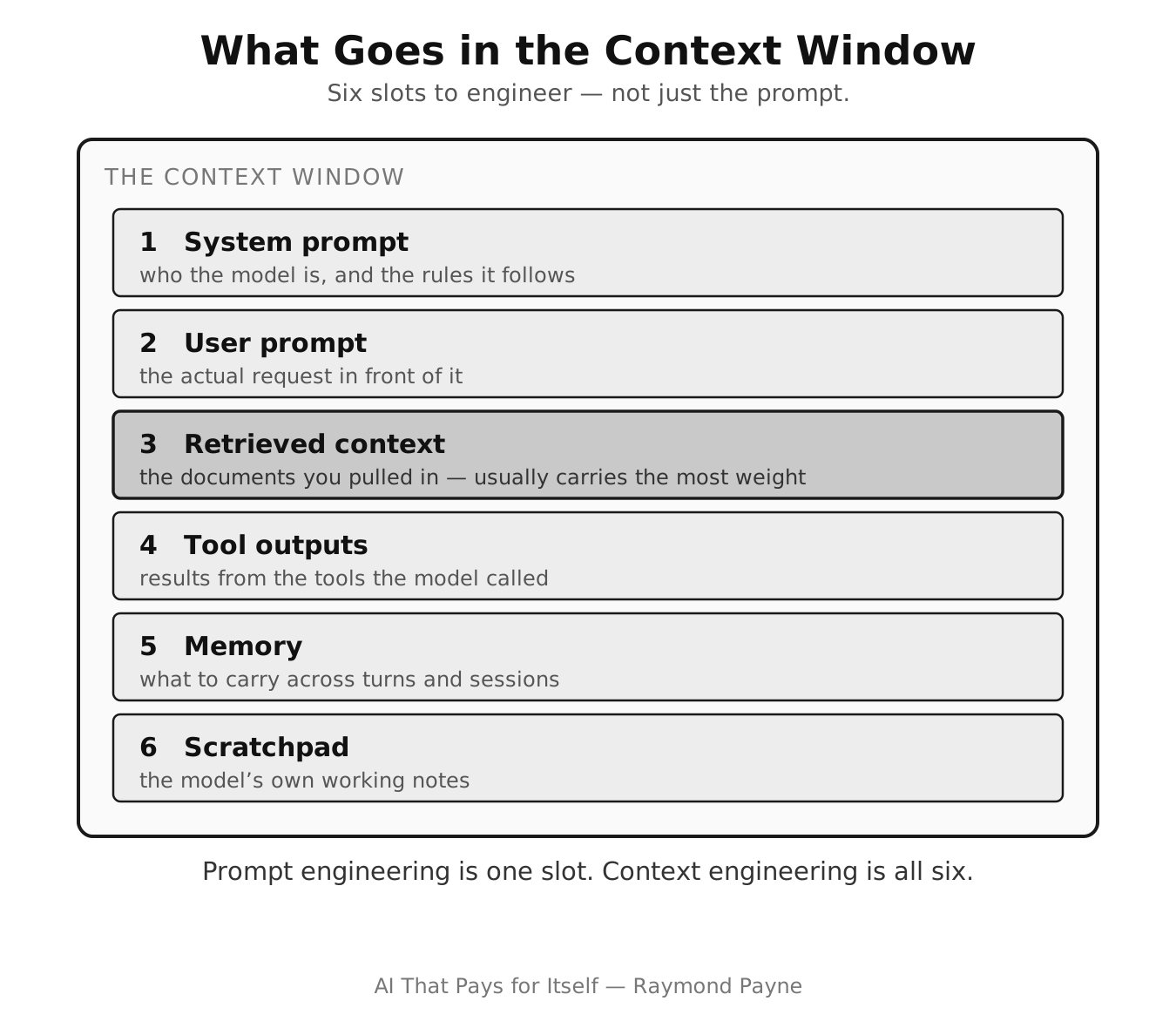
Six-slot context checklist
Before any AI feature ships — or when diagnosing why one is giving wrong answers — walk all six slots and ask: what is actually going in here, and who decided that? An empty or defaulted slot is usually where the next failure is hiding.
The six slots
| # | Slot | What belongs here | What we have today (fill in) | Owner |
|---|---|---|---|---|
| 1 | System prompt | Standing instructions: who the AI is, what it must always do, what it must never do, tone, format rules | ||
| 2 | User message | The actual request for this turn — the question, task, or input the user or system is submitting right now | ||
| 3 | Retrieved context | Facts pulled from your knowledge base to answer this specific question — your policies, contracts, product data, case history. This slot fails most often and most quietly. | ||
| 4 | Tool outputs | Results returned when the agent called a function — customer record lookup, inventory count, calculation result, API response | ||
| 5 | Memory | Durable knowledge carried over from past sessions — preferences, prior decisions, running account of the relationship or project | ||
| 6 | Scratchpad | The model's own working notes as it reasons through a multi-step task — intermediate conclusions, things to check, draft plans |
The slot that needs the most attention
Slot 3 — retrieved context — is not in the same weight class as the other five. It fails quietly, repeatedly, and in ways that look like the model's fault but are not. For any feature that draws on your own documents, policies, or knowledge base, these are the questions to answer:
- ☐ Are the documents we feed this system current, correct, and complete? Who is responsible for keeping them so?
- ☐ Are there conflicting versions of the same document reachable by the system? (The system cannot tell which is right — it will serve whichever it finds.)
- ☐ Have we tested retrieval on the hard questions — the ambiguous query, the one that spans multiple documents, the one whose answer lives in a footnote?
- ☐ Can the vendor show retrieval quality metrics (faithfulness, answer relevancy, context precision)? If not, we are trusting a search we cannot see.
Audit questions for any AI feature
- ☐ For each slot above: is something going in, or is it blank / default?
- ☐ For each slot: who decided what goes in — or did nobody decide and it is just the default?
- ☐ Which slot has nobody looked at? That is where the next failure is likely hiding.
Feature audited
Feature / workflow: ______
Date reviewed: ______
Reviewed by: ______
Slot that needs work: ______
Want a second set of eyes on this in your firm? The no-sell promise applies — if it isn't a fit, I'll tell you in the first ten minutes.
Book a 30-Minute Call →